
Ledger.com/start – Secure Crypto Wallet Setup Guide
Ledger.com/start is the official setup page for Ledger hardware wallets. It helps users safely configure their crypto wallet and manage digital assets with advanced security features. Whether you are using a Ledger Nano S Plus or Ledger Nano X, the setup process is simple and beginner-friendly.
To begin, users visit Ledger.com/start and download the official Ledger Live application for desktop or mobile devices. After installing the app, connect your Ledger hardware wallet using a USB cable or Bluetooth connection. The platform then guides you through wallet initialization, PIN setup, and recovery phrase backup.
One of the biggest advantages of Ledger hardware wallets is offline private key storage. This security method protects crypto assets from phishing attacks, malware, and unauthorized access. Ledger Live also allows users to buy, sell, stake, and manage multiple cryptocurrencies in one secure dashboard.
Key features include:
- Advanced security protection
- Support for thousands of cryptocurrencies
- Easy portfolio management
- Secure recovery phrase backup
- Real-time crypto tracking
Using the official Ledger website helps ensure a safe setup experience and reduces the risk of scams. Always verify the website URL before entering wallet information or downloading software.
Why Clear Signing matters
As users become more aware of the need to protect their private keys, attackers have adapted. The weakest point is no longer key storage, it’s the presentation layer. Today, users are often asked to approve transactions they do not fully understand. Behind a simple “Approve” button, there can be complex smart contract interactions, hidden permissions, or malicious intent.
In 2025 alone, more than $3 billion in crypto assets were stolen, with a significant portion of attacks exploiting the presentation layer, taking advantage of users blindly signing transactions.
Clear Signing directly addresses this shift. At its core, Clear Signing combines two essential components:
- Trusted screens, ensuring that what is displayed cannot be tampered with.
- Transaction understandability, allowing users to verify what they are actually approving.
Trusted screens are well addressed by specific hardware architectures, such as our hardware signers. But understandability introduces a different scaling challenge. Each transaction type, each new DeFi protocol, or the myriad of other crypto use cases require specific metadata to be correctly interpreted and displayed.
This is the problem Ledger set out to solve with ERC7730: a standard designed to make transaction intent consistently interpretable and scalable across the entire ecosystem.
1. Clear Signing: From Idea to Standard (History)
What is Clear Signing?
Traditional wallets often require users to approve transactions as opaque hashes or raw data. Because these payloads are not human-readable, and can hide malicious intent, this process is known as blind signing. And signing a transaction you can’t read is like signing a blank check.
Clear Signing addresses this by making transaction intent understandable.
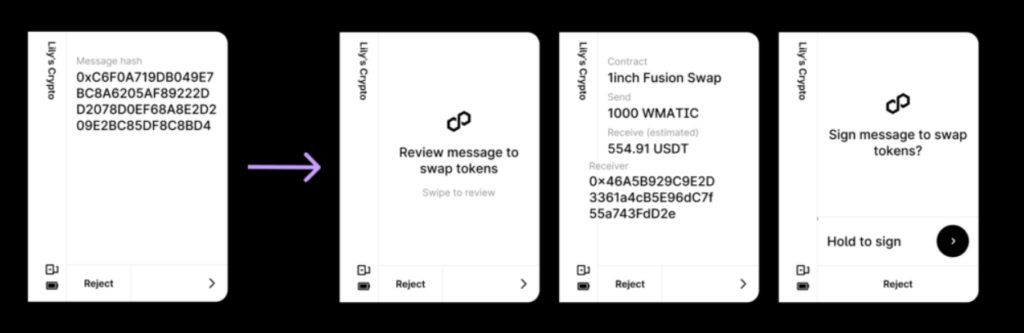
Like we said above, Clear Signing relies on two key components: a trusted screen and readable transaction details. While a trusted display (specifically, the secure screen of a Ledger hardware device) ensures that transaction data cannot be tampered with, they do not make that data understandable.
Raw transaction payloads are not designed to be read by humans. To make them meaningful, they need to be enriched with structured metadata such as:
- The action being performed (e.g. transfer, approve, swap),
- The assets and amounts involved, converted in human readable units,
- The counterparties or contracts being interacted with,
- Contextual labels that make the interaction meaningful.
Without this information, even a secure screen cannot prevent blind signing.
Clear Signing is therefore not just about displaying data, it’s about providing the right data, in a way that can be consistently interpreted and presented to users.
Early Implementations and Limitation
Ledger devices have always clear-signed basic blockchain interactions like simple transfers of native currency or tokens. The first implementation of an extensible framework for Clear Signing on Ledger devices dates back to 2021, with the introduction of Ethereum plugins.
These plugins allowed specific dApps to define how their transactions should be interpreted and displayed on the device. In practice, this meant embedding custom logic directly into the Ledger Devices to decode transaction data and present meaningful information to users.
This approach was both innovative and flexible. It enabled tailored, protocol-specific experiences and significantly improved transaction readability compared to blind signing.
However, it came with inherent limitations. Each new integration required:
- Dedicated development effort.
- Deep knowledge of Ledger’s hardware architecture.
- Ongoing maintenance as protocols evolved.
As the number of protocols and use cases grew, this model became increasingly difficult to scale. Supporting the long tail of applications meant continuously adding new code to the device, a process that was both time-consuming and resource-intensive.
To move forward, a different approach was needed. We then introduced the Generic Parser. Instead of embedding decoding logic directly into the device, the model shifted toward a more generic mechanism: a parser capable of interpreting structured metadata.
This marked an important evolution, moving complexity away from device-specific code, and toward describing what should be displayed, rather than how to compute it.
Toward Standardization
Given the constant scaling challenges we were facing, it became clear that in order to scale Clear Signing beyond isolated implementations, standardization was necessary.
So in 2024, we started the Clear Signing Initiative, with the idea to provide support and open-source tools to the entire ecosystem in order to scale security for everyone.
Then, in 2025, we released the ERC7730, the first Clear Signing open standard. A first attempt to standardize how transaction intent could be described and interpreted.
This was a key step forward in the mission to address blind signing: it moved Clear Signing from a feature to a shared specification.
Though standardization was a significant milestone, for the whole ecosystem to benefit, scaling needed to follow along with improvements in the implementation.
2. Why ERC-7730 Needed a v2
What ERC-7730 v1 Enabled
ERC7730 v1 introduced a standardized way to define how transactions should be formatted and displayed to users, enabling Clear Signing. It enabled more consistent user experiences, improved security, and laid the foundation for interoperability.
For the first time, Clear Signing could extend beyond isolated implementations, and external contributors could help us scale it by contributing to the Ledger clear-signing-erc-7730-registry repository.
Where Clear Signing Had Room to Grow
Despite these improvements, several limitations remained. As adoption grew, so did the limitations.
First, parts of the specification remained closely tied to Ledger’s initial implementation. While this made early adoption easier, it introduced constraints that made it harder for other actors to fully embrace and extend the standard.
Second, the scope of ERC7730 V1 was largely shaped by the most common use cases at the time. As the ecosystem evolved, new requirements emerged, including:
- Cross-chain interactions.
- Privacy and encryption-related flows.
- More advanced conditional logic.
These were not always well supported, due to missing standard elements and formatters.
Additionally, the specification lacked expressivity in certain scenarios. This became particularly visible in real-world integrations. For example, supporting complex patterns such as ERC-4626 Vault files often required maintaining dozens of separate ERC7730 definitions, making related metadata harder to scale and maintain.
Ultimately, governance and ownership became a bottleneck. ERC7730 was initially introduced within a very specific Ledger context, which made it closely tied to particular systems and assumptions. This made it harder to evolve as a true ecosystem-wide standard.
These limitations made it clear that a new iteration was needed.
3. ERC-7730 v2 – A Collaborative Evolution
To address these limitations, the next iteration of ERC7730 was not developed in isolation. A dedicated working group was formed within the Ethereum Foundation, bringing together multiple actors from across the ecosystem, including wallet providers, infrastructure teams, and security experts. This collaborative approach ensured that ERC7730 V2 would reflect a broader set of use cases and requirements.
Expanding Clear Signing for a broader ecosystem
ERC7730 V2 expands the scope of the Clear Signing specification to match the reality of today’s ecosystem: more diverse, more complex, and increasingly cross-chain.
It introduces several key capabilities:
- Support for cross-chain interactions.
- Compatibility with both hardware and software wallets.
- Considerations for privacy and encryption use cases.
At the same time, the specification has been redesigned with long-term evolution in mind, including multiple quality-of-life improvements to simplify maintenance and integration.
The specification is now more expressive, enabling complex use cases without requiring fragmented definitions. It is more structured, reducing ambiguity and improving consistency across implementations. All of which makes it easier to integrate, lowering the barrier for adoption across wallets, protocols, and chains.
Together, these changes make Clear Signing not only more powerful, but significantly more scalable, bringing it closer to becoming a standard that can be adopted across the entire ecosystem.
A Community-Driven Effort
For a decade, Ledger stood as the pioneer of Clear Signing, defining the standard when few others were even looking at the problem. However, for a security protocol to truly protect the entire industry, it must be neutral and community-governed. We are now passing the torch to ensure that human-readable intent becomes a universal right for every crypto user.
ERC-7730 V2 is the technical embodiment of this shift. More than an upgrade, it is the result of collaboration with external contributors, reflecting a broader set of requirements and perspectives, such as the Ethereum Foundation, WalletConnect, Fireblocks, Sourcify, Trezor, and Cyfrin.
While Ledger users will still find the most seamless and holistic Clear Signing experience with a Ledger signer paired with Ledger WalletTM, the broader Ethereum ecosystem will now benefit from the transparency and security standards we first brought to life.
Clear Signing is no longer a Ledger feature; it is truly becoming a shared standard.
ERC-7730 v2 addresses many of the technical limitations of the initial specification. But improving the standard is only part of the challenge. For Clear Signing to scale across the entire ecosystem, it also requires neutral governance and long-term stewardship.
4. From Ledger initiative to Ecosystem Standard: Governance evolution
Governance matters for standards, as adoption is not just a technical challenge; it’s a trust challenge.
Technical specifications alone do not guarantee adoption. For a standard to succeed, it needs to be neutral, transparent, and maintained over time. Without this, even well-designed specifications struggle to gain traction.
Separating the specification from a single actor is critical to ensure it can evolve with the ecosystem and ensure its longevity.
Transition to the Ethereum Foundation
To address these challenges, we decided that the governance of ERC7730, in the form of ownership of the ERC7730 registry, should be transitioned to the Ethereum Foundation. This move provides neutral stewardship, increased credibility/transparency, and a stronger foundation for adoption. More info on the governance of the standard on this dedicated page.
This is a key step to turn ERC7730 into a true ecosystem standard. Read the full announcement about Ledger passing stewardship of Clear Signing to the Ethereum foundation.
Open-Source Tooling and Ecosystem Support
Standardization also requires the right tools. This is why, in parallel, the tooling that we internally developed around ERC7730 is being open-sourced to support the whole ecosystem and developers.
As of today, the tools that we provide and open-source are:
- Linter – Verifies the correctness of the format against common sense rules.
- Tester – Runs test transactions or messages against real implementations.
- Analyzer – LLM-powered security audit of an ERC-7730 metadata file.
- Generator – LLM-powered generation tool of an ERC-7730 from source code.
These tools make it easier to create, validate, audit, and implement ERC-7730 definitions.
What This Changes Going Forward
With this technical and governance evolution, ERC-7730 and Clear Signing are entering a new phase. This enables:
- A more open and collaborative model.
- Long-term stability and maintenance.
- Broader ecosystem adoption across wallets and protocols.
- The ability to verify and audit clear signing definitions at scale.
Together, these changes move Clear Signing closer to becoming a core part of the Ethereum Infrastructure, levelling up security for every user.